Hyōshō Kirigakko
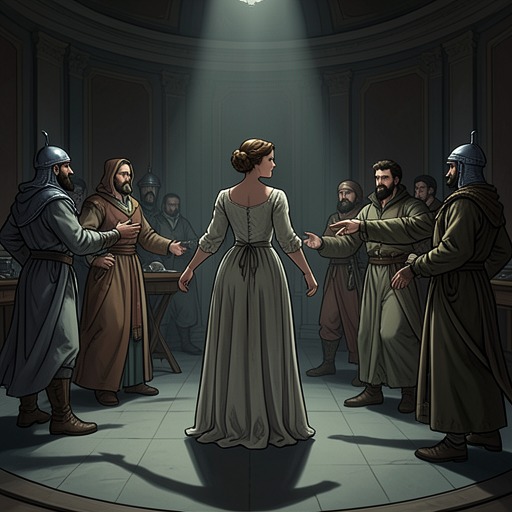
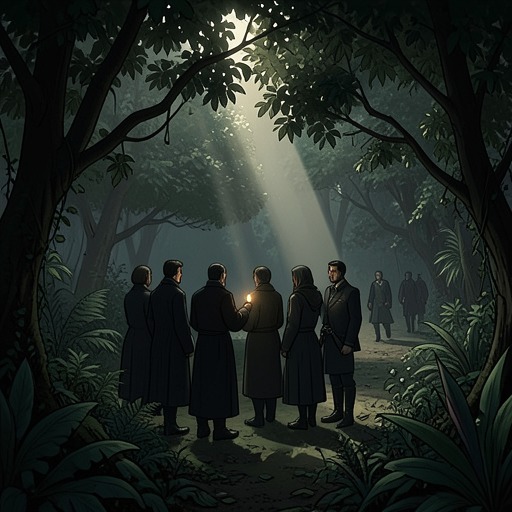
Chasing SunlightThe Reflected Council is a covert organization whose presence links the expedition of Jonathan Heights to the hidden political and informational networks operating beyond ordinary human institutions. Although its internal structure and ultimate objectives remain undisclosed, the narrative presents it as a power capable of recruiting people with exceptional abilities, placing agents in dangerous environments, and pursuing interests that must be concealed even from allied authorities. Its significance lies less in open command than in the uncertainty it creates: the Council’s influence is felt through intermediaries, surveillance, intelligence, and carefully maintained fictions.
Nature and Sphere of Influence
The Council operates under the wider authority of the Illuminated King and alongside the Royal Inquisition, but it is not simply identified with either institution. The expedition is assembled under the imprimatur of the Illuminated King and the nefarious endorsement of the Reflected Council, placing the organization at the intersection of official power and concealed agendas. Crown agents and underworld interests join Jonathan Heights aboard the Endeavor, yet the motives of those participants remain uncertain, suggesting that the Council’s endorsement does not amount to transparent political sponsorship.
Its reach extends into the eastern frontier, where human civilization meets territories occupied by nonhuman peoples and where the Inquisition is simultaneously strongest and weakest. At Danby’s Point, human authority tries to contain contact with darker forces while accepting the inevitability of trade. The Council belongs to this unstable borderland of knowledge and power: it depends on access to places and beings that official institutions distrust, while preserving enough secrecy to avoid exposing the full nature of its dealings.
Agents and Methods
The Council’s most visible asset is the unusual skill of its personnel. When Marie and Sarah lead the search for Robert across bare stone, Jonathan cannot understand how they are tracking someone without closely examining the ground. He treats their ability as one of the mysteries associated with the Reflected Council and concludes that the organization collects people with highly unusual talents. This moment defines the Council through capability rather than exposition: its methods are demonstrated as effects that ordinary observers cannot readily explain.
The organization also works through secrecy and controlled appearances. Eleanor recognizes that her allegiances are not secret, yet she acknowledges that certain fictions are better maintained. Her remark places the Council within a political culture where practical cooperation depends on preserving misleading surfaces. The Council’s operations therefore do not rely solely on force; they rely on compartmentalized knowledge, selective disclosure, and agents who can move between incompatible loyalties without making the underlying arrangement explicit.
Its informational reach is especially evident at Danby’s Point. Tiuni provides Jonathan with intelligence about the movements of the third house among the Thrantin, the altered routes of caravans, the positions of forces and beasts, and the shifting growth of the Verdant Expanse. Jonathan has no idea how the fractured gathers such information, but he regards it as indispensable and habitually consults her before venturing beyond human lands. The Council is not explicitly shown directing every piece of this intelligence, but its association with unusual skills and covert business places such knowledge within the same hidden economy on which its authority depends.
Relations with Jonathan Heights and the Expedition
The Council’s connection to Jonathan Heights is both enabling and coercive. It is implicated in the expedition’s authorization and in the network that allows the Endeavor to reach the eastern edge of human civilization, yet Jonathan does not treat its interests as identical with his own. His purpose is the search for sunlight, while the Council represents concealed institutional motives that accompany him without being fully revealed.
Jonathan’s relationship with the Council is also marked by distance. He is familiar with the kinds of places where the Council conducts business, but he admits that he would probably not feel at ease in them. His experience gives him practical knowledge of nonhuman environments, whereas the Council’s operations appear to depend on a deeper and more unsettling fluency. This contrast helps explain why he can guide companions through alien cities without becoming a transparent representative of the organization: he knows how to survive its world, but does not possess or disclose all of its secrets.
The Council’s surveillance function becomes explicit when Antomine accompanies Eleanor and Jonathan into Angkor Leng. Jonathan knows that Antomine is not motivated by material wealth and infers that his purpose is surveillance. Antomine does not trust Jonathan, and Jonathan recognizes that the inquisitor’s suspicion is justified even while insisting that he has no reason to expose Angkor Leng’s secrets. The scene reveals a triangular tension among Jonathan’s private expeditionary aims, the Inquisition’s official duties, and the Council’s concealed interests. The Council’s power is therefore exercised not only through agents who gather information, but through the suspicion that information is always being gathered about the expedition itself.
Political Tensions and Consequences
The Council’s covert position becomes especially consequential when Antomine argues that a possible nest of Umbraught in Angkor Leng must be purged. He fears that, having learned of zint, the Umbraught might hunt it and carry the danger westward. Jonathan rejects the proposal because the Endeavor is not a navy and lacks the time and resources to survey and cleanse a city as large as Angkor Leng. His refusal is also a refusal to let the Inquisition’s priorities displace the expedition’s central objective.
This dispute exposes a fundamental conflict between institutional responsibility and individual purpose. Antomine argues that civilization is built by doing more than the bare minimum, so that present actions either assist or endanger those who come later. Jonathan responds that the threat is unproven from his perspective and that Antomine has offered no workable means of addressing it. The Reflected Council’s presence intensifies this conflict because it makes every unexplored danger politically charged: a place may contain treasure, intelligence, hostile forces, or secrets whose value exceeds the expedition’s declared mission.
The organization’s influence also shapes the expedition’s internal balance of power. Eleanor later feels more secure because the recovered wealth allows the travelers to outnumber the King’s people, particularly the Lux Guards accompanying Antomine. Jonathan, however, remains wary of Antomine’s unknown abilities and suspects that the inquisitor’s talents will remain useful. The Council’s hidden role is reflected in this uncertainty. Even when material wealth changes the visible balance among the travelers, concealed expertise and institutional affiliation continue to determine who can observe, intervene, or control events.
Narrative Function and Significance
The Reflected Council embodies the book’s recurring opposition between visible civilization and the obscured systems that make civilization possible. Human society presents itself through illuminated tracks, paperwork, gates, zint lamps, and official institutions, yet its reach into the eastern darkness depends on intelligence gathered by agents whose skills and loyalties are not understood. The Council is thus a “reflected” power in structural terms: it appears indirectly, through the people and information it places in motion, rather than through an openly described command center.
Its secrecy also prevents the expedition from becoming a simple adventure under a single banner. Jonathan may claim a clear goal, but the presence of the Council ensures that the journey is never politically innocent. Maps, trade routes, nonhuman territories, salvage, surveillance, and proposed extermination all become part of the same contested field of knowledge. The organization helps turn exploration into an instrument of power while preserving enough ambiguity that neither Jonathan nor the reader can confidently reduce its motives to benevolence or malice.
By associating the Council with both useful intelligence and dangerous concealment, the narrative refuses to separate knowledge from control. The Council’s agents make travel possible, yet their very competence signals that the expedition is being watched and used. Its most important effect is therefore not a single revealed policy, but the persistent pressure of unseen interests: wherever Jonathan moves beyond human lands, the question of who knows what, who is gathering it, and who intends to act on it remains inseparable from the search for sunlight.